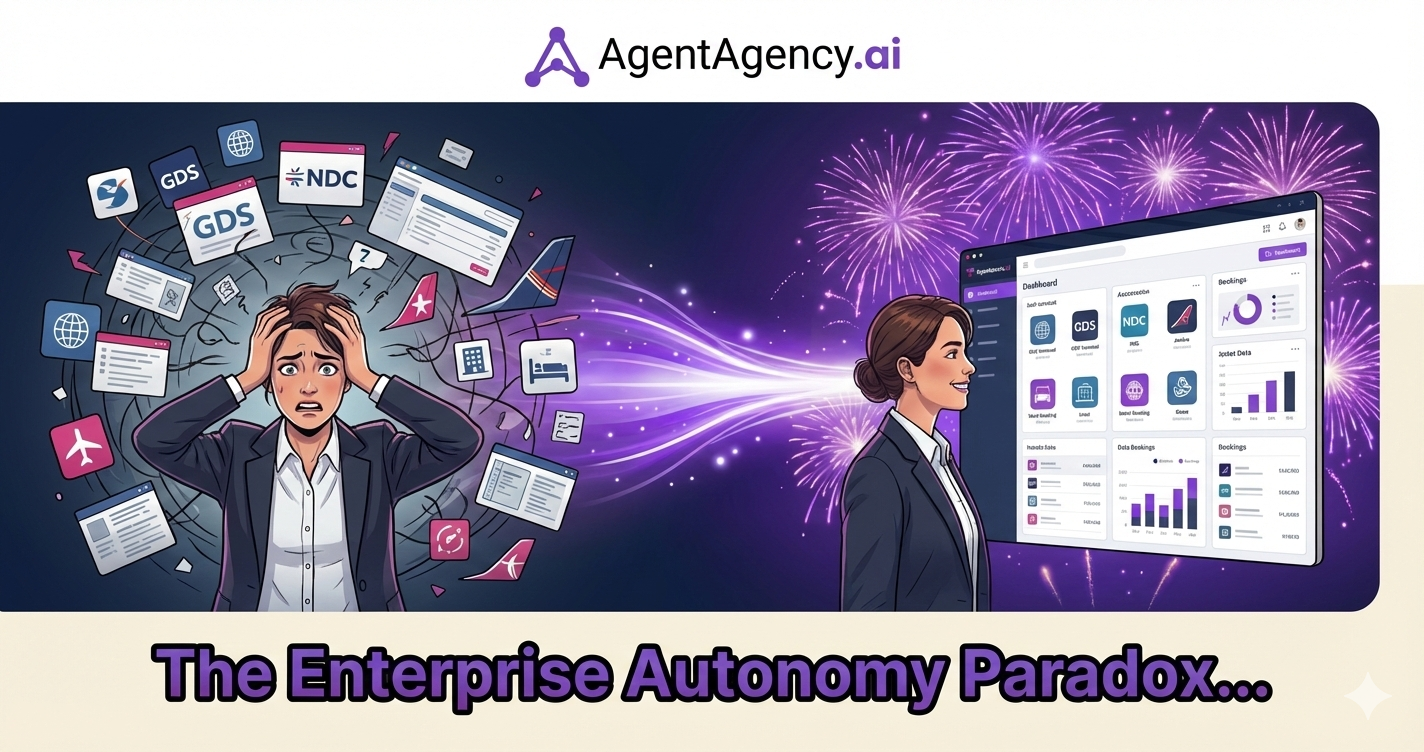
The Enterprise Autonomy Paradox: Why More Organizations Deploy AI Agents—Just as Fragmentation Makes It Impossible
Author: Lasse Vinther, Founder of AgentAgency
Published: February 2, 2026
Reading Time: 7 minutes
Location: Cape Town, South Africa | Serving: Enterprise Organizations Across South Africa & Globally
The Dream Vs. the Reality
"We deployed our first agent. It worked. Then we added a second one for compliance. Now nobody knows who authorized what."
That's what one Cape Town enterprise operations director told us last month. She'd greenlit an agentic AI pilot in late 2025. Four months later, the technology worked. The governance didn't.
Every agent decision sat alone. Compliance violations slipped through. Audit trails vanished. What should have been a productivity multiplier became operational friction.
We've watched this pattern repeat across dozens of South African enterprises. The story rarely changes: agent autonomy promises efficiency. Fragmentation delivers confusion.
At some point—usually around the second or third agent—autonomy quietly turns into a governance problem.
You can't orchestrate what's broken.
This creates the core paradox of 2026: more agent deployments than ever before, just as the governance landscape makes scaling them increasingly difficult.
In South Africa specifically, POPIA compliance and operational complexity demand precision decision-making. Fragmentation isn't just inconvenient. In regulated environments, it becomes a liability.
The Fragmentation Breaking Enterprise Operations
What Changed?
Agentic AI shattered the old centralized decision model. Instead of one system making decisions, enterprises now operate collections of semi-autonomous agents—each optimized locally, rarely coordinated globally.
As AI expert Lasse Vinther, MD of Automation Architects, noted in recent industry coverage: "AI commerce, or what will become agentic AI commerce, is more likely to encroach on the traditional OTA's territory, rather than the very bespoke and niche ITC." The same principle applies across enterprise environments—autonomous systems work best when they're bespoke and orchestrated, not fragmented across multiple domains.
Industry leaders are already describing the symptoms. Speaking to Travel News, one travel executive described how teams now navigate "multiple fragmented workflows instead of one orchestrated system."
We see the same thing in enterprise deployments. When organizations roll out their third or fourth agent, we ask a simple question: How do your agents coordinate?
The answer is remarkably consistent: They don't. And they contradict each other.
That's the problem. Agents don't orchestrate themselves. Coordination only happens when it's explicitly designed—and governed.
The Consequence: The Five-System Expertise Tax
Enterprise teams now need to master five operational domains just to deploy a single orchestrated workflow:
| Operational Domain | 2023 Reality | 2026 Reality | Complexity Cost |
|---|---|---|---|
| Single-Agent Deployment | Primary focus | Legacy approach | 2–4 weeks |
| Multi-Agent Coordination | Non-existent | Mandatory for scale | +6–8 weeks |
| Governance Frameworks | Optional | Critical requirement | +4–6 weeks |
| Audit Trail Architecture | Post-deployment | Pre-deployment necessity | +3–5 weeks |
| Escalation Path Definition | Ad-hoc | Systematic requirement | +2–3 weeks |
| TOTAL ORCHESTRATION | N/A | Required for production | +350% complexity |
A decade ago, deploying one agent was cause for celebration. Today's multi-agent environments quietly destroy the simplicity that made early pilots so appealing.
As one enterprise technology leader put it, fragmentation has pushed operations teams into multi-workflow environments that demand constant oversight and ongoing governance maintenance.
The result is predictable: operations teams become governance administrators, not strategic leaders.
The Window Is Closing (But Not Yet Closed)
The Enterprise Autonomy Exodus Paradox
Major organizations are consolidating AI strategies, even as experienced teams deploy agentic systems faster than ever. Industry analysis consistently ranks agentic AI among the top enterprise automation priorities for 2026.
Yet the catch is becoming clearer: deployment alone isn't enough.
As Gartner has noted, success depends less on how many agents are deployed and more on how well they're orchestrated.
The Critical Question
How long before enterprises realize they can't scale agents without orchestration?
Right now, many deployments still appear sustainable. Pilot success masks governance gaps. Early agents work because they're simple: one task, one decision path, one owner. Teams celebrate 70–75% time reductions and greenlight expansion.
Those buffers don't last.
The window is roughly 12–18 months. After that, the productivity gap between governance-first and governance-late deployments becomes impossible to ignore. Organizations stuck in fragmented architectures face a stark choice: rebuild (expensive) or abandon (more expensive).
What This Means: The Agentic AI Problem You Can't Ignore
Orchestration First, Then Scale
Here's what gets missed in the rush to deploy agents: agentic AI works best on well-orchestrated, governed processes.
If agents make isolated decisions without coordination, you don't have governance. You have faster chaos.
Vinther explains the opportunity differently: "I think great human service is something that customers will continue to willingly pay a premium for, however the expectation is that the service and discovery is instant and automated for non-critical matters, which AI assists with." This principle applies directly to enterprise governance—human oversight remains critical, but AI automation should handle routine orchestration tasks instantly, freeing human judgment for genuinely complex decisions.
When orchestration is designed in from the start, everything changes.
A unified orchestration layer allows multiple agents to:
- Coordinate decisions across workflows without conflict
- Apply business rules consistently
- Flag exceptions for human judgment automatically
- Maintain audit trails for POPIA, GDPR, aviation, and financial compliance
- Escalate intelligently when confidence drops below safe thresholds
Fragmented deployments simply can't match this.
The Real-World Example: Travel Agency Automation (And Why It Matters to Every Enterprise)
The travel industry offers a clear illustration of how fragmentation plays out in practice.
In a recent Travel News feature on agentic AI and independent travel consultants, industry voices including eTravel, XL Travel, Club Travel, and Travel Counsellors highlighted how increasingly complex, multi-system workflows are reshaping day-to-day decision-making. As noted in the coverage, teams navigate "multiple fragmented workflows instead of one orchestrated system"—a challenge that extends far beyond travel into every sector managing autonomous systems.
These platforms are investing in solutions to help their networks operate more efficiently. Yet the underlying orchestration challenge persists across the industry. Consider a travel services company deploying three agents:
Agent A (Quote Generator): Creates service quotes
Agent B (Compliance Checker): Validates regulatory requirements
Agent C (Invoice Manager): Issues invoices
In isolation, each performs perfectly. Agent A cuts quote generation from 3.2 hours to 0.8 hours. Agent B flags compliance issues. Agent C triggers payment workflows.
But when Agent A proposes something Agent B rejected the day before, contradictions emerge.
Without orchestration—without rules that enforce verification, escalation, and authority—independent agents quietly undermine each other. Regulatory exposure increases. Financial accuracy degrades. Audit trails fragment.
The same pattern appears across industries:
- Financial services: risk agents conflict with pricing agents
- Logistics: optimization clashes with compliance constraints
- Manufacturing: quality agents contradict supply chain decisions
- HR: hiring agents generate offers compensation agents can't approve
The industry changes. The orchestration gap does not.
The Numbers: Why Governance-First Wins
Organizations that take a governance-first approach see measurably different outcomes.
From real deployments:
- 75% reduction in task generation time
- 87% faster decision response times
- 10 hours per week saved per team member
Financially, this translates into reclaimed capacity, reduced rework, and measurable operational growth.
The critical detail: these gains only materialize after orchestration is in place. Early phases are often messy. Agents conflict. Visibility is limited. Leadership confidence wobbles.
Teams that commit to orchestration stabilize. Teams that don't usually abandon the initiative—joining the 40% of agentic AI projects Gartner expects to be scrapped by 2027.
The Bottom Line
We're at an inflection point.
More organizations are deploying agentic AI than ever before. At the same time, the cost of fragmentation is becoming harder to ignore.
South African enterprises, shaped by POPIA, audit requirements, and operational resilience, are uniquely positioned to get this right—if governance and orchestration are treated as architecture, not afterthoughts.
"In this age of autonomous systems, what matters isn't how many agents you deploy—it's how well you orchestrate them."
References & Research
This article draws on:
- Gartner: Enterprise AI spending trends, agentic AI adoption and failure forecasts (2025–2027)
- AgentAgency customer deployments: Anonymized timelines, ROI metrics, orchestration patterns
- South African regulatory guidance: POPIA compliance and auditability requirements
- Travel News (January 14, 2026): Coverage examining fragmented workflows, agentic AI adoption, and operational pressure in the travel industry, featuring insights from AI expert Lasse Vinther, MD of Automation Architects